
Information Security Manual (ISM) | Cyber.gov.au
Information Security Manual (ISM) | Cyber.gov.au


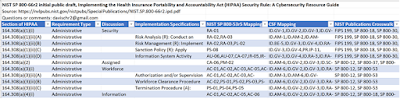
Here's a NIST mapping crosswalk between the HIPAA requirements and NIST SP 800-53r5 in a spreadsheet format.
Spreadsheet Here: 2022 HIPAA Crosswalk SP 800-66 ipd Table 12.ver.01.xlsx - Google Drive from Blog Downloads (compliancequickstart.com)
Publication Link: NIST SP 800-66r2 initial public draft, Implementing the Health Insurance Portability and Accountability Act (HIPAA) Security Rule: A Cybersecurity Resource Guide
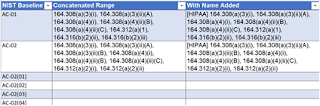
I reworked the information from the initial public draft into a spreadsheet that also allows easy importing into different tools. Additionally, I included a direct NIST map, essentially reversing the look-up. Finally, all control IDs are now two digits which allows for proper sorting and lookups with tools inside arrays.
Here's a snapshot of the format (click to view):


Credit to HBR and specifically Dorie Clark. Brilliant. Young people need to hear this.
Don’t Focus on Your Job at the Expense of Your Career (hbr.org)
Summary: "The gap between what we have to do today and where we see ourselves in the future can be vexing. We’d like to advance toward our goals, but we feel dragged down by responsibilities that seem banal or off-target for our eventual vision. In this piece, the author offers four strategies you can try so that you can simultaneously accomplish what’s necessary for the short-term while playing the long game for the betterment of your career."

What: They have collaborated on a joint initiative to solve a critical bottleneck in the sharing of threat information: The different data formats currently in use across multiple cybersecurity tools and products.
Thoughts: There's still a tremendous amount of work
to be done and it will realistically be quite some time before the value is
realized from this effort. However, it's good to see some progress and
interest. This has been a problem for a very, very long time.
Tags: Open Cybersecurity Schema Framework (OCSF)
Sources:
Tags: MITRE; CREF; Navigator; Cyber Resiliency Engineering Framework; NIST SP 800-160
Source:
What is it?
“a relational database of NIST SP 800-160 Volume 2 concepts that is searchable, visualizes resilience relationships & presents a Web UI while utilizing portable, opensource components to enable use in tools. The CREF Navigator distills tons of useful terms, tables, and relationships from the CREF/NIST SP 800-160 Volume 2 into an online tool.”
Must-see Images:
Visualize the interaction between the Goals, Objectives,
Techniques, and Approaches of Cyber Resiliency:

Interaction of Techniques, Approaches, and Adversarial
Effects:

The knowledge base is available to you. You can do it! Find the time and prioritize the effort. Focus on the outcome. Focus on your why and make it bigger than the effort to get there. There are hundreds of books available. Dozens of free resources. Google is your friend... Or if you prefer, here's a tiny snippet of online available resources:
Many top schools have open courseware such as:
In addition, there are great free online courses available:
And if you have a subscription (it's worth it IMHO):
CMMC depends on the content from 800-171r2 and 171A... Here is something I created that combines all three into one place. I find this helps visualize and focus discussions between the driver (CMMC) requirement, implementation, and assessment.
Download it from my files here: 2022 CMMCv2 and SP 800-171r2 and SP 800-171A Combined.ver.02a
Relevant Sources:
Tags: NIST; Quantum-Resistant Cryptographic Algorithms
Source: NIST Announces First Four Quantum-Resistant Cryptographic Algorithms | NIST
Big news in the standards world!
Why do I care?
Taken from a different blog, this is why quantum resistant cryptographic algorithms are important today:
“Rather than breaking an entire class of encryption in total and all at the same time, an adversary would have to collect that encrypted information and then apply the quantum capability against that single session of communication, break that, and then move to the next one.
We don’t anticipate talking about your personal bank accounts at first, but rather very valuable information that will be worth the expense of using those first cryptographically capable quantum machines, national security information as an example. That's why, even though there's not a cryptographically relevant quantum machine now, we need to be preparing now so that even the data we have today is quantum proof tomorrow.”
What just happened?
Synopsis…
NIST Announces First Four Quantum-Resistant Cryptographic
Algorithms
Federal agency reveals the first group of winners from its six-year competition
The algorithms are designed for two main tasks for which encryption is typically used: general encryption, used to protect information exchanged across a public network; and digital signatures, used for identity authentication. All four of the algorithms were created by experts collaborating from multiple countries and institutions.
For general encryption, used when we access secure websites, NIST has selected the CRYSTALS-Kyber algorithm. Among its advantages are comparatively small encryption keys that two parties can exchange easily, as well as its speed of operation.
For digital signatures, often used when we need
to verify identities during a digital transaction or to sign a document
remotely, NIST has selected the three algorithms CRYSTALS-Dilithium, FALCON and SPHINCS+ (read as “Sphincs plus”).
Reviewers noted the high efficiency of the first two, and NIST recommends
CRYSTALS-Dilithium as the primary algorithm, with FALCON for applications that
need smaller signatures than Dilithium can provide. The third, SPHINCS+, is
somewhat larger and slower than the other two, but it is valuable as a backup
for one chief reason: It is based on a different math approach than all three
of NIST’s other selections.