Practical governance. This blog is about understanding and addressing risk. Systems and architectures continue to rapidly converge, hiding complexity with additional layers of abstraction. Simplicity is great for operations - as long as risks are understood and appropriately mitigated.
Sunday, November 5, 2023
IT Audit Process - Review
Thursday, October 19, 2023
Navigating the Waters of Change
This information was gathered to help people at VMware as many prepare for the pending Broadcom acquisition by Lorelei Ghanizadeh Voorsanger | LinkedIn. Thank you, Lorelei, for sharing with so many others that need this information. You are a blessing. And thank you to the hundreds of people that have reached out to me and my peers with resources and help. You are appreciated.VMware peers, you are seen. Reach out to me. I have a lot of resources that may be helpful.
Update Your LinkedIn Profile
- Consider verifying your LinkedIn profile.
- Get a nice professional looking headshot: Take professional headshots at home.
- Update your tagline using, e.g. "position | keywords | mission (optional)"
- Update your background picture. Consider www.canva.com. Several free designs.
- Ask for letters of recommendation: Request a recommendation on LinkedIn
- Notify recruiters (and optionally your network) that you are open to opportunities
- Add your resume to your profile: Add profile section | Recommended | Add featured | + | Add media
Improve Your Resume
- Rezi: Rezi - The Leading AI Resume Builder
- TealHQ: Free AI Resume Builder (tealhq.com)
- Jobscan: Free Resume Templates for 2023 (jobscan.co)
- MS Word: File | New | Search for Online Templates | Resume
- Etsy: ATS Compliant Resume - Etsy
- Adobe: Free resume builder
- Grammer Check: Grammarly: Free Writing AI Assistance
- NovoResume: Free Resume Templates for 2023 (novoresume.com)
- OpenAI: ChatGPT
- Coverdoc.ai: AI-powered cover letter writing & research assistant
- Indeed: Free Cover Letter Templates | Indeed.com (great primer/discussion as well)
The AWS Cloud Resume Challenge
Manage the Job Search
Application Tracker
- Job Search Spreadsheet by The Muse on Google Sheets
- Huntr Job Search Tracker and Autofill from Google Chrome
Job Search Sites & Placement services – US-centric
- Indeed
- Glassdoor Jobs
- HiringCafe
- Monster
- ZipRecruiter
- SimplyHired
- CareerBuilder
- Jobs and talents in InfoSec / Cybersecurity | infosec-jobs.com
Practice Interviews
- Common Interview Questions | LinkedIn (pay attention to the categories)
- InterviewPrep AI
- Yoodli.AI
Manage the Offer
- Harvard Business Review’s 15 Rules for Negotiating a Job Offer
- TheMuse’s How to Negotiate Salary: 37 Tips You Need to Know
- MoneyGeek’s The Ultimate Guide to Negotiating Your Salary
Wednesday, September 20, 2023
PCI DSS Vulnerability Scanning and Penetration Testing Hygiene
| Image: Dalle3 |
Vulnerability Scans (11.3.1.3 and 11.3.2.1)
One of the critical security controls that PCI DSS v4.0 emphasizes is the need for internal vulnerability scans. Companies must perform these scans after any 'significant change,' as defined by the standard. Significant changes include things like adding new hardware, software, or making considerable upgrades to existing infrastructure.
The scans aim to detect and resolve high-risk and critical vulnerabilities based on the entity’s vulnerability risk rankings. Following the scan, any detected vulnerabilities must be resolved, and rescans should be conducted as needed.
External vulnerability scans are equally important and follow the same triggering mechanism—significant changes in the environment. Here, the focus is on resolving vulnerabilities scored 4.0 or higher by the Common Vulnerability Scoring System (CVSS). As with internal scans, rescans are required as necessary to confirm that vulnerabilities have been adequately addressed.
Penetration Testing (11.4.2, 11.4.3)
Internal penetration testing is a more aggressive form of evaluation and should be conducted at least once every 12 months or after any significant change to the infrastructure or application. The testing can be carried out either by a qualified internal resource or a qualified external third-party, provided that there is organizational independence between the tester and the entity being tested. Notably, the tester doesn't need to be a Qualified Security Assessor (QSA) or an Approved Scanning Vendor (ASV).
Much like its internal counterpart, external penetration testing is required annually or after any significant alterations to the system. The testing must also be conducted by qualified resources and should follow the entity’s defined methodology for testing.
What Constitutes a 'Significant Change'?
PCI DSS v4.0 is pretty broad in what it considers to be 'significant changes,' effectively encompassing any new hardware, software, or networking equipment added to the Cardholder Data Environment (CDE), as well as any replacement or major upgrades to existing hardware and software in the CDE. The list is exhaustive and is aimed at ensuring that any changes, no matter how seemingly minor, are given adequate attention from a security perspective.
Summary of Requirements
The PCI DSS v4.0 requirements for vulnerability scans and penetration testing provide a structured approach for entities to keep their data environments secure. While these requirements might seem stringent, they offer a well-defined framework for securing cardholder data against the backdrop of ever-advancing cyber threats. Adhering to these requirements is not just about ticking compliance boxes; it’s about taking the necessary steps to protect your organization and its stakeholders.
- Internal
vulnerability scans:
- 11.3.1.3
Internal vulnerability scans are performed after any significant
change as follows:
- High-risk
and critical vulnerabilities (per the entity’s vulnerability risk
rankings defined at Requirement 6.3.1) are resolved.
- Rescans
are conducted as needed (significant changes..).
- External
vulnerability scans:
- 11.3.2.1
External vulnerability scans are performed after any significant
change as follows:
- Vulnerabilities
that are scored 4.0 or higher by the CVSS are resolved.
- Rescans
are conducted as needed (significant changes..).
- Internal
penetration testing:
- 11.4.2
Internal penetration testing is performed:
- Per
the entity’s defined methodology, at least once every 12 months
- After
any significant infrastructure or application upgrade or change
- By a
qualified internal resource or qualified external third-party
- Organizational
independence of the tester exists (not required to be a QSA or ASV).
- External
penetration testing:
- 11.4.3
External penetration testing is performed:
- Per
the entity’s defined methodology, at least once every 12 months
- After
any significant infrastructure or application upgrade or change
- By a
qualified internal resource or qualified external third party
- Organizational
independence of the tester exists (not required to be a QSA or ASV).
- Significant
changes are defined in PCI DSS to include (PCI-DSS-v4_0.pdf page 26):
- New hardware, software, or networking equipment.
- Any replacement or major upgrades of hardware and software.
- Any changes in the flow or storage of account data.
- Any changes to the boundary.
- Any changes to the underlying supporting infrastructure such as changes to directory services, time servers, logging, and monitoring.
- Any changes to third party vendors or services provided on behalf of the entity.
Thursday, September 14, 2023
Using Maturity Levels and Qualitative Measurement for Visualizing Technology Implementations
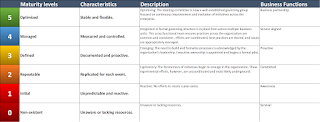
Check out this maturity model. What does it mean to measure the maturity of a technology implementation qualitatively? And how can maturity levels help visualize the current and future states to meet control requirements?
Let's unpack these concepts and show how qualitative measures can enrich the maturity model process, particularly with the use of visualization techniques like bar or radar graphs.
Maturity models serve as diagnostic tools, usually consisting of a sequence of maturity levels that provide a path for improvements. These models are vital for benchmarking and identifying the best practices that need to be implemented for organizational success. In technology implementation, they can gauge how effectively an organization is meeting its control requirements—be it in data security, governance, or software development lifecycle.
The Qualitative Dimension
While numbers and metrics provide a certain level of clarity, they often lack context. Qualitative measurements step in here to provide nuanced insights into otherwise cold data. Through expert interviews, case studies, and scenario analyses, qualitative assessments can address 'how' and 'why' questions that numbers cannot.
One of the powerful ways to present the qualitative aspect of maturity models is through visualization. A bar or radar graph can be used to overlay the current and future states of an organization's maturity levels.
Current State
Imagine a bar graph where the X-axis represents different control requirements like "Data Encryption," "User Access Management," and "Compliance Monitoring," and the Y-axis represents maturity levels from 0 (Non-existent) to 5 (Optimized). The current state can be represented by blue bars reaching up to the current maturity level for each control requirement.
This visualization allows stakeholders to immediately grasp which areas are well-managed and which need improvement. It's not just about the height of the bar but the story behind each bar—which can be enriched by qualitative inputs like expert opinions, employee feedback, and process reviews.
Future State
In the same graph, future state scenarios can be represented by a different color—say, green bars—overlaying or adjacent to the current state bars. These future state bars are not arbitrary but are informed by qualitative measures like scenario planning, risk assessments, and strategic discussions.
The juxtaposition of current and future states in one graph offers a compelling narrative. It shows where the organization aims to be, providing a clear vision for everyone involved.
Utility of Qualitative Maturity Models
Maturity levels, when fleshed out with qualitative measurements, offer more than a snapshot of the present; they provide a roadmap for the future. Visual representations like bar or radar graphs give life to these qualitative insights, making them easy to understand and act upon.
So, the next time you consider assessing your organization’s technology maturity, think beyond numbers. Look at the stories those numbers can tell, and use qualitative measures to fill in the gaps. And don't just keep these insights in spreadsheets and reports—visualize them.
Combine qualitative measures with visualization techniques and build a more meaningful, actionable, and comprehensive roadmap. Aim for a balanced, nuanced, and visually engaging approach to understand the current state and opportunity for improvement.
Example Output
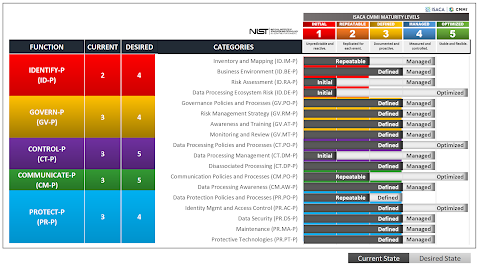
Here's a quick assessment of an organization's adherence to the NIST Privacy Framework. The beauty of this method - by the way - is that it's fast and easy to create this chart using qualitative measures. Search for the Privacy Framework spreadsheet under the downloads section if you want a copy of this.
Tuesday, September 5, 2023
NIST.SP.800-66r2.ipd Worksheet - HIPAA Indexed on NIST
Friday, September 1, 2023
Numbers and Narratives: The Power of Qualitative and Quantitative Feedback
The Quantitative Dimension
In the realm of cybersecurity learning programs,
quantitative data acts as the backbone that offers empirical evidence of
program effectiveness. This data, collected through various channels—from
real-world cybersecurity incidents and metrics on employee reporting to
targeted simulations and longitudinal studies—provides a measurable barometer
of your organization's cybersecurity posture. It can also help tailor training
materials to specific departments, evaluate ROI, and keep content up to date.
This section will detail the key types of quantitative data that you should
focus on, offering a robust framework for continuously enhancing your cybersecurity
initiatives through actionable metrics.
- Cybersecurity Incident Data - Utilize real-world data on past incidents to simulate realistic scenarios in your training programs. For example, if there has been a rise in phishing attacks, including similar scenarios in your learning modules can help prepare the workforce better.
- Metrics on Incident Reporting - Review how many employees report potential cybersecurity events pre- and post-training. An increase in reports post-training could indicate higher awareness.
- Simulated Attack Responses - Phishing simulations can provide invaluable data. If 90% of your employees ignore a phishing email post-training compared to 50% pre-training, you know you’re on the right track.
- Longitudinal Data - Track the program's impact over time to identify trends. Maybe the initial spike in awareness drops after six months, indicating a need for refresher courses.
- Employee Testing Data - Compare employee cybersecurity test scores before, immediately after, and three months post-training to assess knowledge retention.
- Performance by Department - Do tech departments outperform sales in cybersecurity awareness? This could guide department-specific training.
- Training Attendance and Completion Rates - Low attendance or completion could indicate that the training is too cumbersome or not engaging enough.
- Quantitative Surveys and Costs - Use closed-ended surveys for quick, quantifiable feedback. Also, calculate the per-participant cost of developing and delivering the program for ROI assessment.
- Privacy and Technical Metrics - Track the frequency and type of privacy or cybersecurity events to identify the need for role-based training. Changes following technical training—like a reduction in accounts with privileged access—can also be invaluable metrics.
The Qualitative Dimension
While quantitative metrics provide the hard facts, it's the
qualitative data that enriches our understanding by adding context, nuance, and
depth to these numbers. Qualitative feedback captures the human elements that
are often overlooked in cybersecurity initiatives. From capturing employees'
responses about the program's delivery and content to conducting focus groups
for in-depth insights, qualitative data allows us to gauge the intangibles that
make or break a learning program. In this section, we will delve into various
types of qualitative feedback, including presenter evaluations, open-ended
surveys, and even observations from the training sessions, to provide a more
holistic assessment of your cybersecurity education efforts.
- Presenter and Program Feedback - Encourage employees to share feedback on trainers and program content to make real-time improvements.
- Open-Ended Surveys and Reports - Use these to gather nuanced opinions. Maybe the training material is excellent, but the pace is too fast?
- Focus Groups and Observations - Conduct these with a cross-section of employees to get richer insights into the learning experience, identifying areas for improvement.
- Suggestion Box - A suggestion box allows employees to provide candid feedback and innovative ideas for program improvement.
A Marriage of Metrics and Mindsets
Combining quantitative data with qualitative insights will not only paint a comprehensive picture of your program's effectiveness but will also guide data-informed decisions for future improvements. For instance, if your quantitative data indicates high knowledge retention but qualitative feedback points to low engagement, you may need to inject more interactive elements into your program. Because when it comes to cybersecurity, an empowered workforce is your best line of defense.
And if you haven't already, check out NIST Special Publication 800-50 and look for the upcoming Rev. 1. This is a comprehensive guideline that serves as an invaluable resource for information security education, training, and awareness. Thank you to NIST and the industry authors and contributors for your tireless work in advancing the field and providing a foundational resource for cybersecurity professionals everywhere.
Monday, July 24, 2023
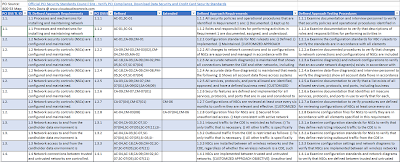
2023 PCI DSSv4 to NIST 800-53r5
I ran across
this again today working on an internal project for VMware. We are a team of
likeminded professionals who enjoy quality work and sharing with the community
to raise the bar for everyone.
What struck me
when I reopened this workbook is remembering the many very, *very* long days.
Mapping is an incomplete science, filled with subjective relationships.
However, starting from scratch, using homegrown tools and my own reading
through the controls, I remapped as accurately as I could the relationship
between the PCI DSS and the body of controls established by NIST SP 800-53r5.
We have our own
internal agendas and projects related to this work. However, the data here can
help someone else struggling with the volume of frameworks and managing the
complex relationships between all of them.
I stand by the
mapping as 90% correct. I've learned through the years there are usually ways
to improve the accuracy of subjective data. Please let me know if you find an
error! Use as you see fit. Look for 2023 PCI DSSv4 to NIST 800-53r5 on davischr2/Cloud-Documents
(github.com) or Blog Downloads (compliancequickstart.com).
#pci #pcicompliance
#nist #sp80053r5
Cross Posted on LinkedIn: PCI DSS to SP 800-53r5 | LinkedIn
Friday, July 21, 2023
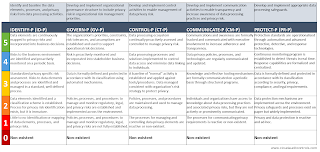
NIST Privacy Framework Maturity Model
The NIST Privacy Framework (PF) is an interesting model for building and assessing a formalized privacy program. Sure - I agree - it's not as detailed as what can be found on ARMA, but it's familiarity with the NIST Cybersecurity Framework (CSF) makes it approachable and easier to share with stakeholders.
This important distinction can help drive interest and stakeholder involvement.
The implementation of any model or checklist is only useful as a point in time assessment, and finding a way to extrapolate quantifiable growth is the key to successful implementation and gaining value from the effort.
And so - along those lines - please enjoy access to a free tool for measuring your privacy framework as it stands currently versus your desired state during the next periodic timetable you choose to set.
It's unlocked. Use as you see fit: Blog Downloads (compliancequickstart.com) or davischr2/Cloud-Documents (github.com)
Cross posted on LinkedIn: NIST Privacy Framework Maturity Model | LinkedIn
Friday, July 7, 2023
Interconnected Disciplines: Security | Compliance | Privacy | Audit | Information Governance
- Security is about fortifying the enterprise against threats and ensuring the confidentiality, integrity, and availability of its data.
- Compliance takes charge of ensuring the organization's adherence to relevant laws and regulations.
- Privacy manages personal data responsibly, safeguarding the rights and expectations of the individual.
- Audit plays a vital role in conducting systematic reviews of the company's records and operations to ensure transparency and adherence to established protocols.
- Information Governance manages information at a strategic level, providing a framework that aligns data handling processes with the overarching goals of the enterprise.
Let's dive a little bit deeper into each one of these.
Criticality of Working Together
Wednesday, June 14, 2023
SOC Trust Services Criteria (TSC) AICPA Excel Spreadsheet Workbook
You can find the result under Blog Downloads (compliancequickstart.com).